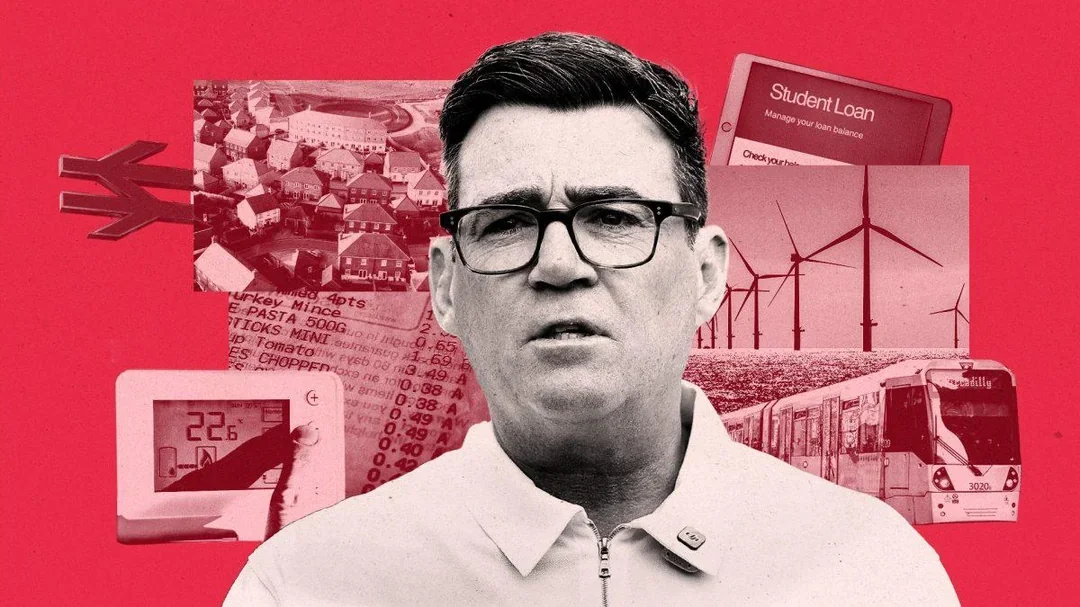
Burnham Government’s First Budget: The Squeeze, the Black Hole, and What Businesses Should Do
Andy Burnham's first Budget on 28 October is an exercise in reconciling promises he has made, fiscal rules he has kept, a defence black hole he did not create, and a war he cannot control. Arcara Strat examines the squeeze, the doom loop the UK economy is stuck in, why the Strait of Hormuz is now a permanent feature rather than a passing shock, and what businesses should do about tax, energy and the devolution opportunity opening up. (Disclaimer: above image taken from Reddit, no copyright intended).

Britain's AI Bet, Part Two: Open, Closed, and the Question of Who Controls the Machines
Should the most powerful AI be open for anyone to build on, or locked inside the companies that make it? Part two of Arcara Strat's AI Week examines the battle now splitting the industry, from Nvidia and Meta to OpenAI and the US security establishment, weighing the case for openness against the case for caution, and asks what the answer means for Britain: whether it emerges from this industrial revolution as a builder with capability of its own, or a renter dependent on decisions made elsewhere. (DISCLAIMER: image taken from Newredo website, no copyright intended).

Britain's AI Bet, Part One: Industrialisation, Jobs and the Transition Gap
Britain launched the first industrial revolution and became the workshop of the world. Part one of Arcara Strat's AI Week asks whether it can lead the next one, examining the country's bet that artificial intelligence can rebuild its industry and create jobs, the graduate-hiring collapse already under way, why frontier chips are the part the rhetoric skips, and what the security failures now surfacing at the top AI labs mean as Britain wires this technology into its public services. (DISCLAIMER: NO COPYRIGHT INTENDED, ABOVE IMAGE TAKEN FROM BRITANNICA).

Andy Burnham's Britain: Governing Through the Storm
Andy Burnham inherits record taxation, £110 billion in annual debt interest and a war-driven energy shock, alongside the worst youth employment figures in over a decade. Arcara Strat examines the three challenges that will define his first year, and the sequencing choices that will determine whether his agenda survives contact with the bond markets. (No copyright intended for the above image).
London Rising: How the Gulf's Broken Security Bet is Redirecting Global Capital and What It Means for UK Real Estate and Banking
The Iran conflict of early 2026 has done more than disrupt energy markets — it has permanently undermined the Gulf's foundational proposition as a safe haven for global capital. By exposing the fragility of the region's outsourced security model and the conditionality of American military commitment, the conflict has accelerated a structural reallocation of wealth toward London, with prime residential enquiries from Gulf nationals and expats already up 15% in the first weeks of hostilities. This paper argues that the reputational damage to the Gulf is durable — a ceasefire changes the urgency, not the direction — and that London's super-prime residential market is positioned to absorb a sustained inflow of Gulf-origin capital over the medium to long term. Against this opportunity, the analysis examines the structural constraints on UK housing supply — Labour's planning challenges, the construction skills gap, and the deregulatory ambitions of a Reform Party riding high in the polls but already tested by the limits of its own rhetoric. The paper concludes with a strategic assessment for banks and lenders, addressing prime London lending, development finance, construction sector exposure, and the long-term opportunity to capture Gulf wealth relationships that, once established, tend to be enduring.
The Proxy World: How AI Will Reshape the Way Ordinary People Interact With Money
The FCA's Mills Review may represent the most significant examination of retail financial services in a generation, not because of what it concludes, but because of what it is asking. What happens when AI stops assisting financial decisions and starts making them? And who controls your financial life when the entity managing your AI agent is not a bank, an insurer, or any regulated firm at all?
At Arcara Strat, we believe the consumer dimension of this transformation is the least understood and the most consequential. The promise is real, AI could democratise access to sophisticated financial guidance for millions who have never had it. But the risks are equally real: financial literacy that atrophies through disuse, hyper-personalisation weaponised against vulnerable consumers, and a winner-takes-most competitive dynamic that hands control of the financial system to whoever controls the data.
The full Mills Review report lands in summer 2026. The competitive positioning that will define the AI-enabled financial services landscape is already underway.
Iran War Update I: Oil at $100, Impact on the UK Economy, Russia Winning, and the Case for Energy Independence.
The Iran conflict has transformed the Strait of Hormuz into the world's most dangerous economic chokepoint, triggering an oil price shock above $100, a fertiliser and food security crisis, a destabilised UK mortgage market, and a Russian windfall — all landing on a UK economy that was already flatlining and uniquely ill-equipped to absorb another systemic blow.
Iran's Economic War: Why the UK Cannot Afford to Look Away
Iran’s use of sanctions resistance, energy leverage, and asymmetric economic tactics forms part of a broader “economic war” that reshapes trade flows, financial stability, and geopolitical influence. For the UK, this is not a distant foreign policy matter but a material economic and security concern.
The central message is clear: the UK cannot afford to look away. A more coordinated approach, integrating economic policy, national security, and diplomatic strategy, will be essential to manage the long-term risks.